Is a 16 SEER worth it?
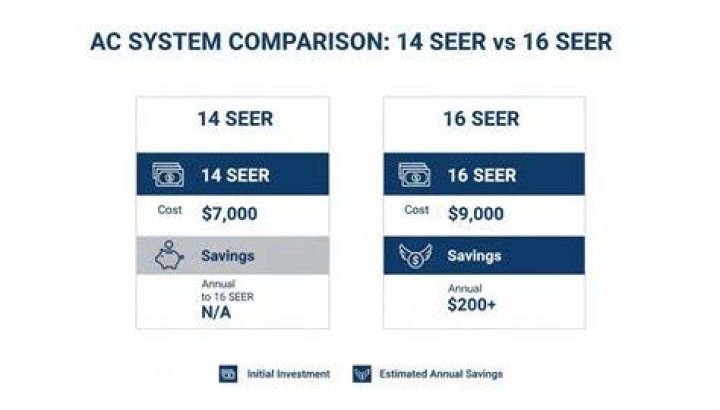
While more expensive than their 14 SEER counterparts, 16 SEER systems offer a significant increase in energy efficiency. In fact, 16 SEER units are up to 13% more efficient, which saves you hundreds of dollars in energy costs over the years.
Is higher SEER rating worth it?
Benefits of a High SEER Rating or Ratio
A higher SEER rating provides greater energy efficiency in certain conditions. The minimum standard SEER for air conditioners is 13, though most modern air conditioners have a SEER that ranges from 13 to 21.
Which SEER rating should I buy?
If you're shopping for a new air conditioner, you may be wondering if you should go with a 14-SEER system (the minimum requirement in our area), or a more energy-efficient system (16+ SEER). Generally speaking, we recommend going with a 16-SEER AC over a 14-SEER AC because it will save you more money in the long run.
Does 16 SEER cool better than 14 SEER?
According to the Kobie SEER Energy Savings Calculator, a 16 SEER unit uses about 13% less energy to produce the same amount of cooling as a 14 SEER unit of the same size. That means that for every $100 you'd pay to run your 14 SEER unit, you could save $13 by upgrading to a 16 SEER unit.
How much more efficient is a 16 SEER vs 14 SEER?
Is 14 SEER going away?
Beginning in 2023, Jon Wayne Heating & Air and every other heating and air conditioning company in the northern half of the United States can no longer install an AC unit with a SEER 13 rating or lower. The new federal regulation means all air conditioners we install are at least SEER 14.
How many SEER do I need?
Since January 2006, all residential air conditioners sold in the United States must have a SEER of at least 13. ENERGY STAR qualified central air conditioners must have a SEER of at least 14. By upgrading from SEER 9 to SEER 14, you can reduce your energy consumption by more than 35%.
Does higher SEER mean colder air?
The higher the rating, the less energy used to produce the same amount of cooling as a lower SEER unit. I emphasize “the same amount of cooling”. A higher SEER rating does not mean more cold air, or colder air, it simply means it produces that cold air more efficiently – meaning lower utility bills for the end user.
Is a higher SEER better or worse?
The higher the SEER rating the more efficient the unit will run, thus leading to lower energy bills. If you compare a 10 SEER AC unit to a 20 SEER AC system, the 20 SEER system will provide twice the efficiency.
Can I deduct my new HVAC on taxes?
Under this new tax law, you can offset the cost of a whole new HVAC system for up to $5,000 or more. And that's just on an average-sized system. Larger commercial systems will have an even more substantial value in savings.
What is price difference between 14 SEER and 16 SEER?
Differences Between 14-SEER vs 16-SEER
The first thing to know is that a 16 SEER unit uses about 13 percent less energy than a 14 SEER unit. In layman's terms, for every $100 you spend with a 14 SEER unit, you would only spend about $87 with a 16 SEER unit.
How much should I pay for a 16 SEER air conditioner?
16 SEER AC Unit Cost
Costs for a 16 SEER AC unit range from $2,000 to $4,000, depending on the size and type. This is one of the more recommended SEER ratings for homeowners who want a more efficient unit but do not want to pay too much upfront. If you live in a warmer climate, this can be a good option.
Does SEER really matter?
The Seasonal Energy Efficiency Ratio is a metric used to measure the ratio of cooling output to the energy consumed. In theory, at least, the higher SEER rating of a unit means the greater energy efficiency you can expect. Unfortunately, SEER ratings don't give a completely accurate picture of energy efficiency.
What size AC do I need for 2000 square feet?
If your home is 2000 square feet, you can calculate your HVAC needs the same as you would for a 1600 square foot home. Assuming one ton of cooling capacity can cool 400 square feet of your home, you'll need about 5.0 tons of air conditioning capacity. Multiply this by 12,000 BTUs, and you'll get 60,000 BTUs.
What size air conditioner do I need for a 1300 sq ft house?
The 1,300-Square-Foot Answer
When looking for the quick answer to how much air-conditioning power you'll need to adequately cool a 1,300-square-foot space, the answer is 23,000 BTUs per hour of air conditioning power. This is the base capacity needed for a 1,200- to 1,400-square-foot house.
Is a higher SEER quieter?
Air conditioning units with higher SEER ratings are often much quieter than those with lower SEER ratings. That's especially true for units with variable-speed compressors because they have quieter fans and don't always operate at full capacity.
Does SEER rating apply to heating?
SEER – Seasonal Energy Efficiency Rating is the most commonly used efficiency rating for both heat pumps in cooling mode and air conditioners. HSPF – Heating Seasonal Performance Ratio is used to measure a heat pump's heating efficiency.
How much is a carrier 16 SEER AC unit installed?
Carrier AC Unit Installation Costs
A standard efficiency 14 – 16 SEER Carrier Comfort series would be your cheapest option costing around $4,700 to install. A highly energy efficient option such as the 21 SEER Carrier Infinity 24ANB1 would be more expensive at $8,300 in total installation costs.
How much is a 14 SEER AC unit?
AC Costs by SEER Rating
The average price for a standard AC unit providing a 13 to 14 SEER rating will cost around $2,770 for total unit installation, while a unit with a 24 SEER rating will cost much more initially at around $6,800 for total installation. See chart below for all SEER ratings and central AC costs.
What is the most efficient HVAC system?
Geothermal systems are by far the most energy efficient HVAC systems. They use the consistent temperature of the earth's surface to heat and cool your home, rather than propane or fuel oil. In particular, an open loop geothermal system is one of the most efficient heating and cooling systems.
What year did 14 SEER become mandatory?
Starting January 1, 2015, split-system central air conditioners installed in the Southeastern Region of the United States of America must be at least 14 SEER.
Can you increase SEER rating?
Did you know that it's possible to raise the SEER rating of your HVAC system without investing in a completely new AC condenser? This loophole 16 SEER involves adding equipment to your current system to make it more efficient.
Do SEER ratings need to match?
The SEER rating of a heat pump or air conditioning system is based on the efficiency of the combination of the condenser (outdoor unit) and air handler (indoor unit). They are required to be matched up by the manufacturer for performance, and the system may have a slightly higher rating than the condenser alone.